Location
Armenian HighlandsNature
CommunityWorshipComplexity
Beginner“Ververi” is a group circle dance that was originally performed in a closed circular formation. The handholds were typically through the pinkies, with hands hanging and swaying, or by holding onto each other’s shoulders (variations with interlocked palms are also known). Dance scholar Srbuhi Lisitsian categorized “Ververi” within the “two forward, one back” family of Armenian dances.
The words “Ver veri,” “ver-ver,” “ververuk,” as well as “Trnotsi,” “Trnoki,” “T’rman,” “T’rvverk,” “T’rveri,” and “T’rvrun” collectively convey the meaning of “flight.” The root “T’r” is also the basis of the Armenian word for “bird” (“T’rchun”). From this root comes the verb “to fly,” which means both “to soar” and “to leap.” Thus, all dances of the “Trnotsi” type are characterized by leaping movements. The term “T’rt’rnel,” derived from the repetitive root “T’r,” mimics the hopping motion of a partridge, similar to the verb “ostostel” (to hop). In folk expressions, “ver-ver ynknil” means “to leap up,” “to jump with joy,” or “to express excitement and happiness.” For this reason, leaders of such jubilant dances were called “Ververichner,” celebrated for their art of high leaps, which symbolized vitality and inspired the younger generation. Similarly, “Veri-ver khaghal” (to play upward) meant leaping joyfully out of sheer happiness.
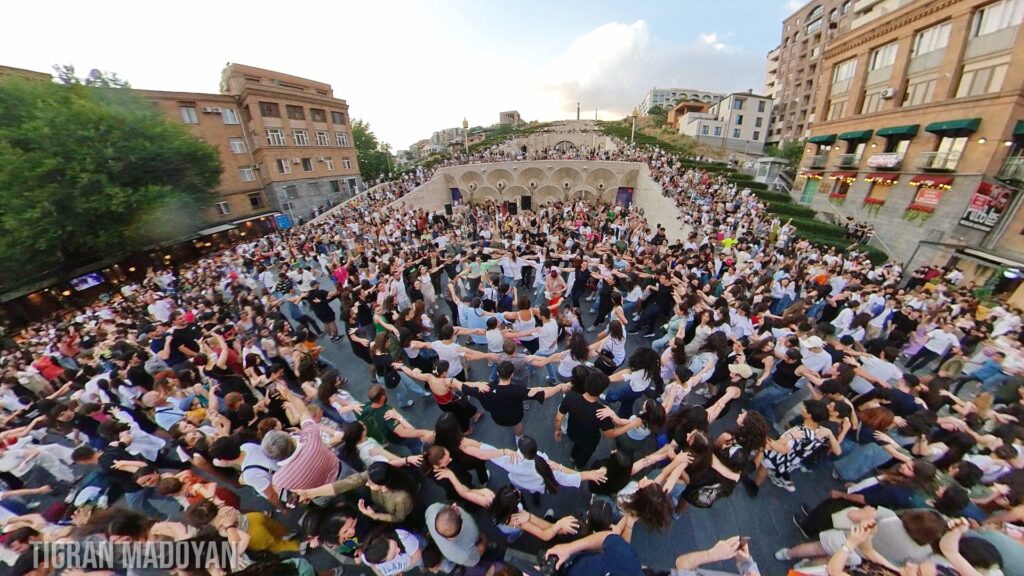
Dances belonging to the “Ververi” family have been documented by nearly all renowned Armenian dance scholars. However, the first scientific description belongs to Srbuhi Lisitsian. Dances of this family were widespread throughout the Armenian Highlands.
The “Ververi” dance has a ritualistic nature, originating during the early totemistic period when birds were venerated. This veneration of birds may represent one of the earliest forms of Armenian belief. At its core lies the national conviction that Armenian deities resided in the sky, while evil spirits and forces lived underground. Therefore, birds were considered the only beings capable of carrying the body—and through it, the soul—closer to the gods, bringing us closer to them. In Armenian dances, leaps and jumps symbolized the dancers’ aspiration to achieve magical influence through the height of their jumps. These movements were thought to positively affect the growth of plants, birds, animals, and the well-being of the entire natural world, as well as the prosperity of one’s offspring. Dancers who performed the highest leaps were considered closer to the gods and enjoyed their favor and providence.