Location
MushSasunNature
ProtectiveComplexity
MediumArmenian dance art includes many protective dances, dance-songs, and other types of dances with protective movements that symbolized the people’s “struggle against evil forces.” “Papuri” belongs to this category of protective dances and was performed on various occasions, such as pilgrimages, ritual ceremonies, and especially during wedding rituals. In different parts of the Armenian Highlands and among the descendants of relocated communities, variations of the “Papuri” dance can be found. Despite their similar nature, they exhibit minor or more significant differences.
The “Papuri” dance is mostly typical to the central regions of historic Armenia, particularly the Taron region, specifically Sasun and its surrounding regions. However, versions can also be found in Van and Hayots Dzor. The first recording of the “Papuri” dance was made by Srbuhi Lisitsian, who collected five versions narrated by Gabriel Petrosyan, Arshak Babayan, Heriknaz Hartenyan, Khoren Davtyan, and Movses Ter-Hovhannisyan. After Lisitsian, this dance type was also studied by several other dance researchers.
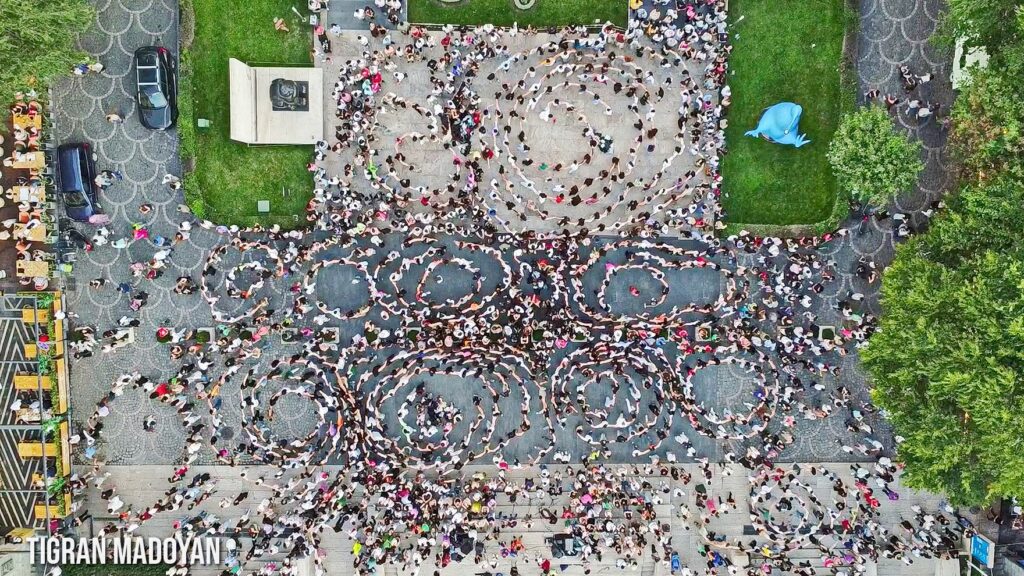
“Papuri” is a circle dance performed in a closed circle. The observed Sasun version consists of two parts: First part: “Moderate,” Second part: “Jumping.” The dance accelerates, and at its peak tempo, the leader signals a transition, and the melody shifts to the jumping part, or as some narrators describe it, “Papuri’s ver veri.”
In the moderate or calm part, the dance steps are accompanied by springs on the balls of the feet, except for steps involving stomps (5th, 7th, and 8th), where the supporting foot performs a knee bend. The spring system of the feet can be summarized as follows: steps involving movement are accompanied by two springs on the supporting foot, while steps at place without movement (close step and step touch) involve one large spring.
The etymology of “Papuri” is relatively simple, as its meaning fully corresponds to the significance of the root word “papara,” which also aligns with the content of the “foot stomping” steps in the dance. The meanings of “papara” are: 1. Beating, 2. Grinding, crushing, 3. Severe punishment, 4. Physical and moral slap, 5. Disaster, calamity.