Location
MushSasunNature
MartialComplexity
ExperiencedOriginally, Yarkhushta was a martial game, which later transformed into a martial dance. Over time, the game element of Yarkhushta diminished, giving way to more dance-oriented movements. Yarkhushta represents a transitional form between a game and a dance. The martial game is characterized by dramatized pantomime dialogues between individuals and groups, duels, competitive gameplay, and the presence of winning and losing sides. It is one of the most beloved dances among the people and remains in practice to this day, especially in villages inhabited by descendants of Sasun. The roots of the Yarkhushta dance are deeply embedded in the Sasun region, expanding throughout the Taron area.
The word “Yarkhushta” can be interpreted in several ways, but the most likely explanation is that it originates from the combination of the words “Yar” and “Khusht”/“Khshtik.” “Yar” corresponds to the Persian word for “beloved” or “companion,” and “Khusht” refers to “short spear” or “weapon.” Together, they form the expression “weapon companion” or “ally in arms,” which appropriately describes the dance’s history, nature, and essence.
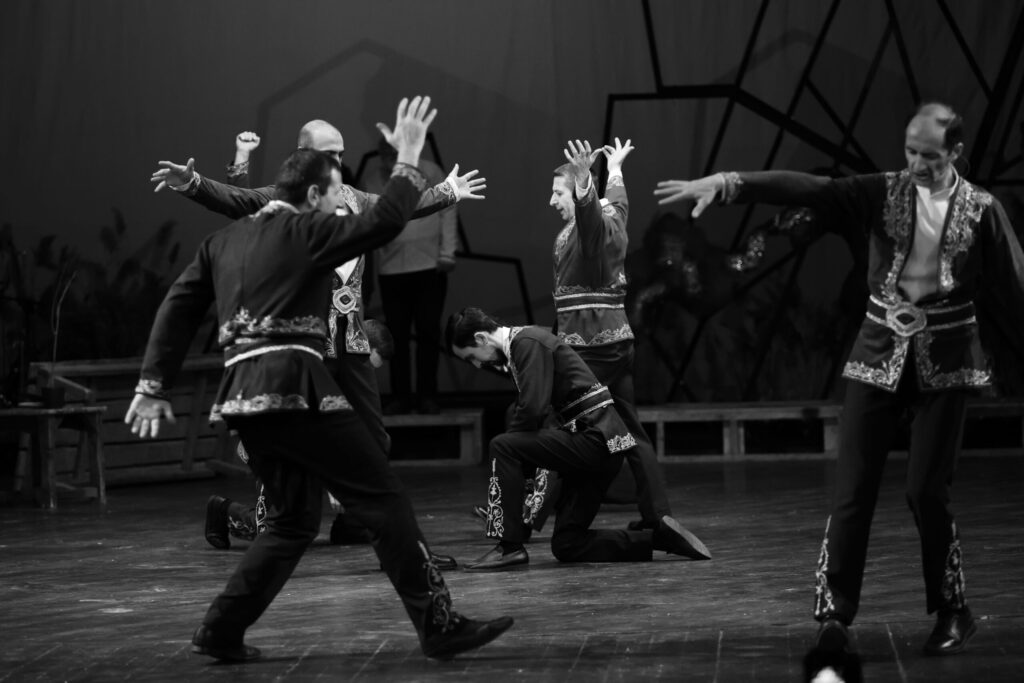
The general arrangement of the dance primarily forms a circle, which periodically breaks apart and reconfigures into two opposing straight lines. These lines advance toward each other as if attacking, then the dancers collide with claps and retreat. This alternation between circular and two-line formations characterizes the primary structure of the dance and symbolizes the concept of infinite cosmic cycles with intermittent breaks.
The main dance step alternates with clapping between opposing pairs and striking one knee to the ground. Dance patterns alternate following traditional rules, but improvisation is also present, especially in the circular formation. Between forming the battle lines, dancers may turn in place, clap their hands, lower their arms, or assume other positions. This part of the dance symbolizes preparation for combat, which begins as soon as the lines dissolve.
The musical meter most commonly falls within a 4/4 time signature. It begins at a moderate tempo and gradually accelerates. Historical accounts indicate that Yarkhushta was traditionally performed with vocal accompaniment.