Location
KarinNature
MartialWorshipComplexity
MediumThe only documentation of the Karno Kochari dance was made by the founder of Armenian ethnochoreography, Srbuhi Lisitsian, in the 1930s, based on information from Shoghakat Ohanyan and Akabi Manukyan, natives of Karin (Erzurum). The dance was revived from Lisitsian’s recording by Gagik Ginosyan in 2001 and was presented to the wider public by the Karin Traditional Song and Dance Ensemble. According to Srbuhi Lisitsian, the root “Koch” is associated with the ram (specifically, an uncastrated, mature ram), referred to as goch, ghoch, or khoch.
Kochari is a ritual martial dance that dates back to the era of nature worship. This vigorous and masculine dance imitates and re-enacts the combat of rams, emphasizing the dancers’ endurance and unconquerable spirit.
Although based on the same ideas and ritual origins, the Kochari dances of different regions of the Armenian Highlands show notable differences and distinctive features. Each regional, city, or village version varies somewhat from its neighbors, reflecting local mentality, lifestyle, customs, environment, and other unique traits.
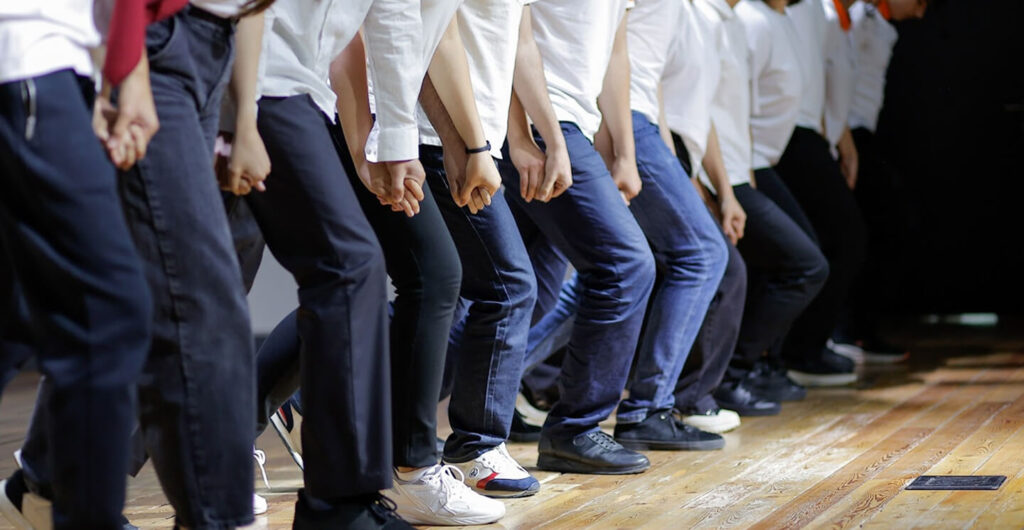
Karno Kochari is a line dance, classified by Srbuhi Lisitsian as belonging to the “two steps forward, two steps back” family of dances.
The dance has three sections: “heavy” (slow tempo), “moderate” (medium pace), and “jumping” (fast pace). These changes take place gradually throughout the performance, with no sharp boundaries between sections. In other words, the transitions follow the gradual acceleration of the music. The melody speeds up so subtly that neither the rhythm nor the general look of the steps seems to change — slow, deep springs shift into moderate pacing, and eventually transform into jumps. In the first section (“two steps forward, two steps back”), each step is accompanied by two spring-bounces. In the second section—the actual Kochari or “ramming” part—each of the four movements involves one deep knee bend, followed by two small springs.
At the beginning of the dance, the steps are accompanied by knee bends; in the middle section, by springs performed on the toes; and by the end, they develop into small jumps.