Location
ParskahaykNature
MartialComplexity
ExperiencedThe version presented here originates from the Armenian regions of Kaputan near Lake Urmia in Persian-Armenia. It is important to note that other versions of the dance were also widespread in Hayots Dzor and Shatakh, which were recorded by Srbuhi Lisitsyan. Similar versions of the dance, and even movements closely resembling it, can also be found in the dance cultures of other ethnic groups in the region, such as Assyrians, Kurds, and Yezidis.
In the dance line, princes, rulers, or those with authority were typically positioned at the beginning, often accompanied by generous offerings (known as shabash) to the zurna and dhol musicians, and sometimes to the poor. Armenians performed “Sheikhani” near monasteries and pilgrimage sites in Hayots Dzor, Van, Timar, Berkri, and other regions during pilgrimages. Among Urmia Armenians, the monasteries of St. Stephen and St. Thaddeus held particular reverence, and the “Ishkhanats Par” (Dance of Princes) was an integral part of annual pilgrimages, festivals, feasts, and especially wedding ceremonies.
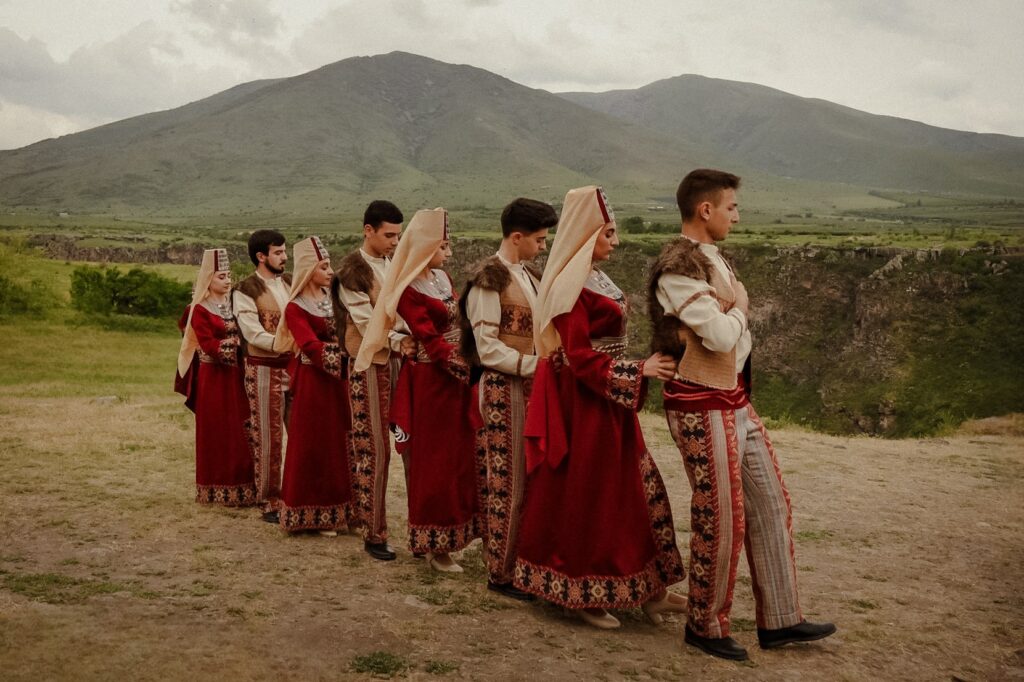
The most commonly used name of the dance among the people is “Sheikhani” or “Sheikhane” (in Shatakh, also called “Sheikhani-Shifalani”). The word “sheikh” comes from the Arabic “sahi” (elder, tribal leader), a term Kurds used to refer to their spiritual leaders or tribal chiefs. Thus, the name of the dance can be interpreted as “the dance of sheikhs,” meaning “the dance of leaders or princes”—”Ishkhanats Par.”
Performing the dance required physical dexterity, significant experience, and skill. Therefore, the dancers were primarily young and middle-aged individuals. The “Ishkhanats Par” stands out for its complex execution, proud demeanor, and regal posture, holding a unique place in Armenian dance art. The dance in its original form consists of a single part that begins in the manner typical of “heavy” dances and gradually accelerates without changing rhythm. Another performance style involves two distinct parts: the “measured” and the “jumping” sections. In the second, faster section, the steps transform into leaps with only minor modifications. The spring system is quite complex, ranging from steps accompanied by one or two knee bends to gliding steps, springs performed on the balls of the feet, and steps involving right and left turns, among others.
The dance was performed in mixed-gender groups. After moving straight forward and returning to the starting position, the dance line shifts to the right through a rightward turn and then straightens through a leftward turn, restoring the original formation. Overall, the entire movement of the dance shifts to the right.