Location
KarinMushSasunNature
WeddingProtectiveComplexity
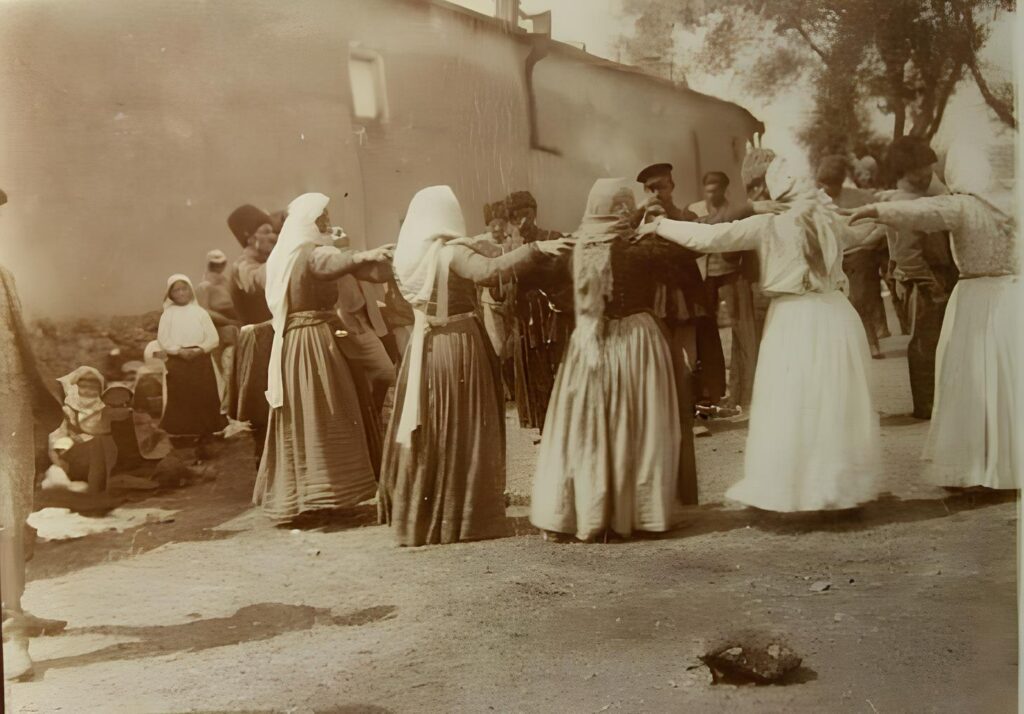
BeginnerThe “Tamzara” dance is found across much of the Armenian Highlands. The most prominent examples come from the village-town of Tamzara, Taron, Alashkert, and Karin provinces. There are also mentions of versions danced in Balou, Kharberd, Sebastia, and Hamshen regions. Similar versions of the “Tamzara” dance appear in the dance traditions of neighboring cultures, such as the Pontic Greek dances known as “Tamzάra” or “Tamsάra.”
The name “Tamzara” appears as the name of a historically Armenian settlement on the Armenian Plateau. This settlement, besides being called “Tamzara,” was also referred to as “Tamarza” or “Tumarza.” Some researchers suggest that the name “Tamzara” originated from Tovma Artsruni, who is said to have founded the settlement. According to Hrachia Acharian, the dance’s name is connected to the settlement’s name.
The music and song associated with “Tamzara” have a 9/8 time signature (commonly 9/8 = 2/8 + 2/8 + 2/8 + 3/8). The counts of the musical and dance phrases align perfectly, ensuring that the dance and music begin and end together.
The music and song associated with “Tamzara” have a 9/8 time signature (commonly 9/8 = 2/8 + 2/8 + 2/8 + 3/8). The counts of the musical and dance phrases align perfectly, ensuring that the dance and music begin and end together. Each dance step is accompanied by a knee bend, while each stomp is accompanied with a spring.
According to Komitas, “Tamzara” is a wedding song-dance, with the main role played by the “gyovundbashi” (leader of the dance) and his assistant. For this dance, the leader was traditionally the godfather, with the bride standing by his side as the dance assistant. Today, the dance has largely lost its ritualistic significance and is performed during various community celebrations.
In all versions of the dance, the stomping movements are believed to ward off evil, serving as protective gestures, especially within the context of wedding rituals.